Tom and I are on a western states road trip. Today we were at Arches National Park near Moab, Utah. These are the first petroglyphs we have seen. I think in addition to the horses, riders and sheep there are at least two dogs in the scene. I usually post at least one photo a day on Facebook, and a different one on Twitter. FB is Susan Cobb Clayton, Twitter is defling01.
Thursday, September 29, 2011


Monday, September 26, 2011
What I’m reading
On a recent trip, we listened to two Michael Connelly books, The Closers and The Brass Verdict. Good listening, but not memorable
The Greater Journey by David McCullough was a wonderful book. It’s long, took me nearly a month to read it, but I truly enjoyed it. It is subtitled, Americans in Paris, and documents the influx of Americans to Paris between 1830 and 1900. I found the chapters on the siege of Paris at the end of the Franco Prussian war gripping, and the chapters on Augustus St. Gaudens fascinating. Recommend for artists, Francophiles and history lovers.
Tomatoland by Barry Estabrook Estabrook is a journalist who writes mostly for Culinary publications. In this book he begins by searching for what happened to the taste of tomatoes. His search takes him to the Andes where the first tomatoes were found, to the hostile infertile fields of Florida, to laboratories and to an old school farmer in Pennsylvania. Much of the book focuses on the plight of Florida migrant workers. Recommend
Partitions by Amit Majmudar is one of those rare and beautiful books that is a treasure to read. It’s just over 200 pages, but each page is poetry set in prose. Every word counts. It is about the displacement of four people during the civil war in India following the partition of India and Pakistan in 1947. The travelers are an ageing doctor, twin five year old boys and a sixteen year old girl. Their journeys are separate, but strangely connected. It’s the best book I’ve read in a long time.
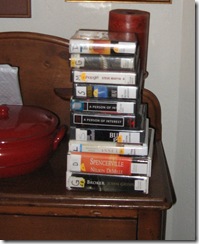
We are going to be taking a road trip soon, here’s the stash of audio books we are taking with us.
The Greater Journey by David McCullough was a wonderful book. It’s long, took me nearly a month to read it, but I truly enjoyed it. It is subtitled, Americans in Paris, and documents the influx of Americans to Paris between 1830 and 1900. I found the chapters on the siege of Paris at the end of the Franco Prussian war gripping, and the chapters on Augustus St. Gaudens fascinating. Recommend for artists, Francophiles and history lovers.
Tomatoland by Barry Estabrook Estabrook is a journalist who writes mostly for Culinary publications. In this book he begins by searching for what happened to the taste of tomatoes. His search takes him to the Andes where the first tomatoes were found, to the hostile infertile fields of Florida, to laboratories and to an old school farmer in Pennsylvania. Much of the book focuses on the plight of Florida migrant workers. Recommend
Partitions by Amit Majmudar is one of those rare and beautiful books that is a treasure to read. It’s just over 200 pages, but each page is poetry set in prose. Every word counts. It is about the displacement of four people during the civil war in India following the partition of India and Pakistan in 1947. The travelers are an ageing doctor, twin five year old boys and a sixteen year old girl. Their journeys are separate, but strangely connected. It’s the best book I’ve read in a long time.

We are going to be taking a road trip soon, here’s the stash of audio books we are taking with us.
Friday, September 23, 2011
Fabric painting
I continue to be fascinated by painting on fabric. Recently I came upon a post about the transformation of an knock-off Eames chair. I was intrigued by the look and wondered if I could do it in fabric.

First I tried the technique described in the Martha Stewart tutorial on paper.

Then I tried it on canvas fabric. Because both paper and fabric are more porous than wood, I did not add water to the paint and glaze mix.

There is something pleasing about the subtlety of the paint on the fabric, but I if I were going to do a major project with this technique, I’d have to explore using house paints and the kind of acrylic glaze used by faux finish painters. Fabric is much more porous than wood or paper, so it used a lot of paint and glaze.
That said, I’m happy with the durability of latex house paint on fabric. I washed my sample in hot water with detergent and dried it in the dryer. There was some very slight fading, but not enough to warrant using expensive fabric paints or fabric medium additive.
Just another technique for the toolbox.
First I tried the technique described in the Martha Stewart tutorial on paper.

Then I tried it on canvas fabric. Because both paper and fabric are more porous than wood, I did not add water to the paint and glaze mix.

There is something pleasing about the subtlety of the paint on the fabric, but I if I were going to do a major project with this technique, I’d have to explore using house paints and the kind of acrylic glaze used by faux finish painters. Fabric is much more porous than wood or paper, so it used a lot of paint and glaze.
That said, I’m happy with the durability of latex house paint on fabric. I washed my sample in hot water with detergent and dried it in the dryer. There was some very slight fading, but not enough to warrant using expensive fabric paints or fabric medium additive.
Just another technique for the toolbox.
Tuesday, September 20, 2011
Design on a Nickel—Finishing the pillows
Aft the pillow tops dried over night, a group of seamstresses came in to teach them to use a sewing machine, turn and stuff the pillows. I had in mind that they would hand stitch the opening closes, but they quickly overruled me and stitched them closed
Here’s one of the boys using my grandmother’s featherweight

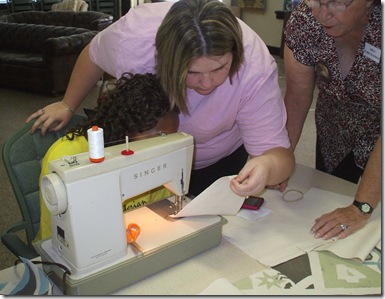


After washing old pillows in hot water, we harvested the filling to stuff the new ones.

TA DA!

Just in case you were wondering about the durability of house paint on fabric, the striped pillow in the photo above was painted on canvas prepared with washing and drying. I did not use any fabric medium, and after a few days, I washed it in the machine in hot water and dried it in the dryer. No appreciable difference in color, and the paint is supple. Amazing.

The final delivery of furniture comes this week, more pictures to come.
Here’s one of the boys using my grandmother’s featherweight


After washing old pillows in hot water, we harvested the filling to stuff the new ones.

TA DA!

Just in case you were wondering about the durability of house paint on fabric, the striped pillow in the photo above was painted on canvas prepared with washing and drying. I did not use any fabric medium, and after a few days, I washed it in the machine in hot water and dried it in the dryer. No appreciable difference in color, and the paint is supple. Amazing.


The final delivery of furniture comes this week, more pictures to come.
Saturday, September 17, 2011
Design on a Nickel—Painting pillows
To prepare the fabric for painting, I purchased natural canvas fabric at JoAnn’s. It’s with the canvas duck, but it does not have the same finish as the colored duck. washed it in hot water with detergent and damp dried it in the dryer, then finished drying it on a clothes rack. After ironing it I cut the fabric in 14” squares and 18” squares.
To introduce the painting to the participants, I had them work on 5” squares using freezer paper, masking tape and rubber stamps. We used the latex house paint left over from painting the room and furniture. They very quickly got the hang of it.


Here are some of their artwork. We let them dry over night


To introduce the painting to the participants, I had them work on 5” squares using freezer paper, masking tape and rubber stamps. We used the latex house paint left over from painting the room and furniture. They very quickly got the hang of it.


Here are some of their artwork. We let them dry over night


Wednesday, September 14, 2011
Design on a Nickel—Scraping and Painting
The young people’s event at church this past weekend was a big success. One of them is an aspiring chef and we started out with a wonderful dinner prepared by Chris and his sou chef TaShai. Yum!
Then they got busy scraping the peeling UV film off the windows, and painting some of the wood furniture.


The coffee table for the room started out like this, a plywood topped activity table.
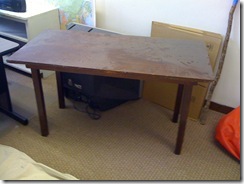
The legs were cut off so it’s 17” high, and it was sanded and painted. Later on, some decorative painting techniques will be applied.

After dinner we moved on to painting canvas to make pillows.
Then they got busy scraping the peeling UV film off the windows, and painting some of the wood furniture.


The coffee table for the room started out like this, a plywood topped activity table.

The legs were cut off so it’s 17” high, and it was sanded and painted. Later on, some decorative painting techniques will be applied.

After dinner we moved on to painting canvas to make pillows.
Friday, September 9, 2011
Sewing with my sister
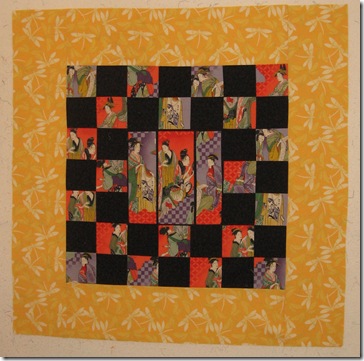
A couple of years before my mother died, she bought my two sisters and me fabric to make kimonos. Last year, Tracy finished them just in time for a family reunion. This week, Tracy wanted to make placemats out of the remaining scraps. They turned out beautifully.
Here they are in process paired with her china and some of the napkins she embellished.

She made some with yellow borders, some with green, and some with purple borders. Here are the green ones with their binding on.

There’s still leftover fabric, and she got inspired and made her first quilt. She’s been bitten badly. I’m meeting her at a sewing store next week to shop for a machine.
Here’s Tracy’s first completed top. I think it is fantastic, plus it’s flat and the corners are square. Quite a feat for a beginning quilter.
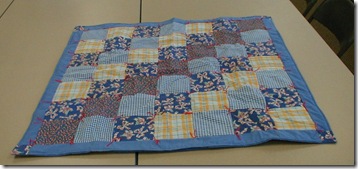
Here’s a photo of my first quilt. It was lumpy and crooked. In my defense I made it under the guidance of a hand quilters guild who cut their squares out by marking with soap slivers around a cardboard template. They were dear women, mostly over 70 who sewed and quilted like they had in the 40's. They opened their fabric cupboards to me and helped me finish it by hand tying. It’s pretty pitiful. Rotary cutters, mats and rulers do wonders for getting a quilt that’s flat and straight. The quilt went to a nursing home patient to keep her warm during Indiana’s cold winters.
Here they are in process paired with her china and some of the napkins she embellished.

She made some with yellow borders, some with green, and some with purple borders. Here are the green ones with their binding on.

There’s still leftover fabric, and she got inspired and made her first quilt. She’s been bitten badly. I’m meeting her at a sewing store next week to shop for a machine.
Here’s Tracy’s first completed top. I think it is fantastic, plus it’s flat and the corners are square. Quite a feat for a beginning quilter.

Here’s a photo of my first quilt. It was lumpy and crooked. In my defense I made it under the guidance of a hand quilters guild who cut their squares out by marking with soap slivers around a cardboard template. They were dear women, mostly over 70 who sewed and quilted like they had in the 40's. They opened their fabric cupboards to me and helped me finish it by hand tying. It’s pretty pitiful. Rotary cutters, mats and rulers do wonders for getting a quilt that’s flat and straight. The quilt went to a nursing home patient to keep her warm during Indiana’s cold winters.

Saturday, August 27, 2011
Design on a Nickel Part—Getting started
The young people at our church have launched a project to refresh and renew their meeting space. With a grant from the congregation we purchased a 7 piece sectional sofa. We also had money for fabric and labor to recover a couple of swivel rockers and purchase window shades. The remainder of the furnishings in the room will be rehabbed. Last weekend a group painted the room, sanded chairs, a bookcase and a table.
The guys took to painting the room like pros; the girls opted for power tools and ran sanders all morning in the room next door. Putting a first coat on the furniture occupied most of the afternoon. The table was an activity table from one of our children's classrooms that had seen better days. Tom cut the legs off and it’s ready to be a coffee table.


The room is now painted, and window shades are hung. On the next workday, they will put another coat of paint on the furniture, and if there’s time start on the pillow project.
Inspired by a number of web posts, I experimented with painting canvas with the paint left over from the project.

The larger pillow top has house paint mixed with fabric medium, the smaller sample is paint right out of the can. After it dries, I’ll see if there is a difference in the hand and durability of the two samples. Web posts are divided as to which method is better.
To make these pillows, I cut wavy shapes out of freezer paper and ironed them on the canvas. After painting, I peeled the strips away.
If this paint holds up on canvas, we have some retro rattan chairs taking up space in an unused room that could have their cushions painted. Like this or this
more later…
The guys took to painting the room like pros; the girls opted for power tools and ran sanders all morning in the room next door. Putting a first coat on the furniture occupied most of the afternoon. The table was an activity table from one of our children's classrooms that had seen better days. Tom cut the legs off and it’s ready to be a coffee table.


The room is now painted, and window shades are hung. On the next workday, they will put another coat of paint on the furniture, and if there’s time start on the pillow project.
Inspired by a number of web posts, I experimented with painting canvas with the paint left over from the project.

The larger pillow top has house paint mixed with fabric medium, the smaller sample is paint right out of the can. After it dries, I’ll see if there is a difference in the hand and durability of the two samples. Web posts are divided as to which method is better.
To make these pillows, I cut wavy shapes out of freezer paper and ironed them on the canvas. After painting, I peeled the strips away.
If this paint holds up on canvas, we have some retro rattan chairs taking up space in an unused room that could have their cushions painted. Like this or this
more later…
Monday, July 25, 2011
What I’m Reading
Patron Saint of Liars—Ann Patchett
I think this was probably her first published novel, written when she was still in her 20’s. It’s set in the 60’s, near Owensboro, Kentucky, and is about the people who live and work in a home for pregnant women who will be giving their children up for adoption. Patchett shines in her ability to give life to her characters. Good read.
Cleopatra—Stacy Schiff
This was not an easy book to get into. The author is primarily a historian who takes pains to use sources as close to the original as possible, but there are no sources from Cleopatra's contemporaries so there is a lot of speculation and reference to the variety of sources. I received an overdue notice from the library when I was on page 121. Oh well.
The Thoughtful Dresser--Linda Grant
I read Grant's novel, The Clothes on Their Backs several weeks ago and while it was good, this one is much better. the subtitle of the book is The Art of Adornment, the Pleasures of Shopping, and Why Clothes Matter. Lest you think yourself exempt from the frivolity of fashion and shopping, her multitudes of examples leave very few women out of the equation. Recommend, for women of all ages.
We Had it So Good Linda Grant
I'm on a Linda Grant kick, in fact, this was the book I heard about that got me started looking for her books. It's a multi-generational novel with good character development and very good writing. It spans the years from the mid 1950's to the present day. When I read the last page, my word for it was depressing. Enough of that, move on. If you want a good Linda Grant book, read The Thoughtful Dresser.
In the Sanctuary of Outcasts--Neil White
This was the book selected for incoming freshmen at Davidson College to read for orientation discussion groups. The author was convicted of bank fraud and sentenced to a minimum security federal prison in Carville, Louisiana. During the time he served, the prison grounds and buildings also housed the last isolated colony of those disfigured by leprosy. The mix of patients, guards, inmates, provides for great reading. It is fascinating, recommend.
I think this was probably her first published novel, written when she was still in her 20’s. It’s set in the 60’s, near Owensboro, Kentucky, and is about the people who live and work in a home for pregnant women who will be giving their children up for adoption. Patchett shines in her ability to give life to her characters. Good read.
Cleopatra—Stacy Schiff
This was not an easy book to get into. The author is primarily a historian who takes pains to use sources as close to the original as possible, but there are no sources from Cleopatra's contemporaries so there is a lot of speculation and reference to the variety of sources. I received an overdue notice from the library when I was on page 121. Oh well.
The Thoughtful Dresser--Linda Grant
I read Grant's novel, The Clothes on Their Backs several weeks ago and while it was good, this one is much better. the subtitle of the book is The Art of Adornment, the Pleasures of Shopping, and Why Clothes Matter. Lest you think yourself exempt from the frivolity of fashion and shopping, her multitudes of examples leave very few women out of the equation. Recommend, for women of all ages.
We Had it So Good Linda Grant
I'm on a Linda Grant kick, in fact, this was the book I heard about that got me started looking for her books. It's a multi-generational novel with good character development and very good writing. It spans the years from the mid 1950's to the present day. When I read the last page, my word for it was depressing. Enough of that, move on. If you want a good Linda Grant book, read The Thoughtful Dresser.
In the Sanctuary of Outcasts--Neil White
This was the book selected for incoming freshmen at Davidson College to read for orientation discussion groups. The author was convicted of bank fraud and sentenced to a minimum security federal prison in Carville, Louisiana. During the time he served, the prison grounds and buildings also housed the last isolated colony of those disfigured by leprosy. The mix of patients, guards, inmates, provides for great reading. It is fascinating, recommend.
Sunday, July 24, 2011
Paper Towel Purse
I’m back in the studio making things that have little practical purpose, but having fun in the process. I’ve been making samples for the fabric painting workshop I’ll be doing with teens in a few weeks. When I get out my paints I have a multi-step process to cleaning brushes.
1. Paint off all excess paint onto sheets of paper. I save the paper sheets for future projects.
2. Squeeze out any remaining paint with paper towels.
3. Swab the brush in a bucket of brush cleaner. I use The Masters brush cleaner. I have been using the same tub for over a year, and I’m generous with it. It looks like it will last another year or two. Again use a paper towel to squeeze out the soap and paint
4. Finally rinse in a bucket or under running water. Very little paint goes down my drain. I’d rather throw paper towels in the landfill than pour wet paint into the water system.
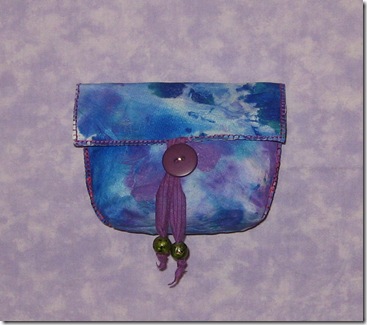
The end result is that I get a lot of painted paper towels. I usually let them dry and throw them out, but one from last night caught my eye. Today, I bonded the paper towel to a piece of fabric using this technique as described in Kelli Nina Perkins book Stitch Alchemy.
The towel was a little bare in some places, so I added a few drops of blue ink and let it dry in the sun. I made a very simple clutch purse, boxed the corners and added a button and ribbon closure with beads. I bought nothing for this project and didn’t take a lot time thinking about what color button, beads, thread, etc.
What will I do with it? Keep it awhile and admire it. It’s only about 4”x5”, so I’m being generous to call it a purse.
1. Paint off all excess paint onto sheets of paper. I save the paper sheets for future projects.
2. Squeeze out any remaining paint with paper towels.
3. Swab the brush in a bucket of brush cleaner. I use The Masters brush cleaner. I have been using the same tub for over a year, and I’m generous with it. It looks like it will last another year or two. Again use a paper towel to squeeze out the soap and paint
4. Finally rinse in a bucket or under running water. Very little paint goes down my drain. I’d rather throw paper towels in the landfill than pour wet paint into the water system.
The end result is that I get a lot of painted paper towels. I usually let them dry and throw them out, but one from last night caught my eye. Today, I bonded the paper towel to a piece of fabric using this technique as described in Kelli Nina Perkins book Stitch Alchemy.
The towel was a little bare in some places, so I added a few drops of blue ink and let it dry in the sun. I made a very simple clutch purse, boxed the corners and added a button and ribbon closure with beads. I bought nothing for this project and didn’t take a lot time thinking about what color button, beads, thread, etc.
What will I do with it? Keep it awhile and admire it. It’s only about 4”x5”, so I’m being generous to call it a purse.

Friday, July 22, 2011
Design on a Nickel
All it took was a project to get me back in the studio again. The young people at our church meet in a room that needs a face lift. One of the easiest and quickest ways is to do this is with pillows. So we’re having a fabric painting workshop. We’re a little short on cash, so we’re not designing on a dime, we’re designing on a nickel.
Here’s the challenge
Teach teens and 20 somethings how to cut, sew, stuff canvas pillows. They will have varying degrees of interest and skills. The desired outcome is to have them make three pillows, two for their meeting space at the church, and one to take home. Some of them may only want to make one pillow, others may want to make as many as time allows.
Fabric—I have unbleached cotton canvas which I have washed to remove the finish that inhibits paint. I’ll pre-cut the pillow tops and backs. They will need to mark seam allowances with rulers and pencils.
Paint—Between my personal stash and the supplies at church we have lots. I’d like to limit the color palette so the room has a cohesive look.
Design and Application—I want to keep it simple, so we’ll use masking tape freezer paper and foam stamps. I’ll need to have some shapes printed on freezer paper ready to cut out.
Stuffing—Since this is design on a nickel, we will not be using purchased pillow forms or even fiberfill. We will cut up old towels and t-shirts and use that for stuffing. The end product might be a bit lumpy, but we’re using canvas, so I don’t think it will be too noticeable.
Sewing—I have two sewing machines I can bring in for the workshop and after the paint dries, we’ll stitch front and back together, stuff and close. For those who are interested, I’ll show them how they can sew the pillow completely by hand.
here are some samples

Masking tape grid

Stamped letters with splatter paint background

Simple rubber stamp shapes

Star shape embellished with gold paint applied with pencil eraser

6” stencils lettering, notice blobs on right side of blue J. Need to figure out some ways to embellish those inevitable mistakes

Freezer paper waves. I think I’ll try adding some text on the white spaces between the stripes, or maybe only on the stripes.
I have some more experimenting to do. I don’t know if it would be too stiff for a pillow, but I’m going to prep some canvas with gesso, and add text with chunky black markers.
This is going to be fun figuring out.
Friday, July 1, 2011
Another day in the kitchen
Today Franky and I tried another recipe from the Harry Potter cookbook. It was a recipe for Harry’s first birthday cake, you know, the one baked for him by Hagrid when he was 11 years old.
First we assembled the dry ingredients and prepared to mix

cakes out of the oven

Mixing up the glaze. We tried smashing the chocolate squares with a mallet, but simply cutting them with a knife worked better.

After making the frosting, we chilled it for awhile, then began to frost the cake

Now the green decorative frosting. We made do with a Ziploc bag instead of a pastry bag and tip. I liked the free form application

Ready to eat!

I hadn’t made a cake for awhile, but it is so much fun to make one from scratch. This one had a lot of steps, but it turned to look exactly like a cake Hagrid would have baked.
Fun Day!
Wednesday, June 15, 2011
What I’m Reading
Sister by Rosamund Lupton
Sister is a beautiful debut novel. The main character receives word that her younger sister is missing. She flies from her home in New York to London only to find that her sister's body is discovered in a desolate area. Although her death is ruled a suicide, her sister refuses to believe it, and thus begins a crime novel and a book about grief. I read it in two days. The writing is superb. Recommend.
State of Wonder by Ann Patchett
Loved it! My daughters used to play a computer game, Amazon Trail. This book was reminiscent of the birds and wildlife of that game, but on a deeper level, there are parallels to Joseph Conrad's classic, Heart of Darkness. The book is skillfully written, and the story is compelling. Basic premise: a research pharmacologist travels to the outer reaches of the Amazon river to follow up on her colleague who has died in the field, and to check on research for a new drug taking place among a tribe with a very unusual culture. Exciting things happen. Recommend.
Caleb's Crossing by Geraldine Brooks
Caleb's Crossing is a historical novel, based on the character, Caleb Cheeshahteaumuck, who was the first native American to graduate from Harvard University in 1665. The next member of his tribe, the
Wampanoag, graduated in May 2011. It is a story of the clash of cultures written when the native Americans were still "selling" land to the new immigrants. Well written, recommend.
March by Geraldine Brooks
Having read and enjoyed both Year of Wonder and Caleb's Crossing, I launched into reading March, another historal novel by Geraldine Brooks. It is a fictionalized account of the father of the March girls who left to join the Union army in his 40's. I found the characters too sentimental and almost put it down several times. Geraldine Brooks should leave the Civil War writings to her husband Tony Horowitz, whose non-fiction book Confederates in the Attic, about Civil War re-enactments was a treasure.
The Poacher's Son by Paul Doiron
A friend I reconnected with at my high school reunion sent me this book as the author is an aquaintance of hers. The central character is a wildlife officer in central Maine. It's at once a crime novel, but also very much a novel with a sense of place. It made me want to learn more about the area where the book is set. The author is the editor of Down East, the Magazine of Maine, and he has a new release, Tresspasser. It was a change of pace for me and I enjoyed it.
House of Prayer No. 2
Even though we have moved from Indiana to Florida, I continue to subscribe to an electronic newsletter from the Vanderburgh County Public Library. House of Prayer No. 2 was one of their non-fiction recommendations. My library in Port Orange had a copy and I started reading it without knowing much about it. I was initially put off by the second person narrative which began the story with short choppy sentences, but I became accustomed to it, and the sentences grew in length and depth as the character moved from childhood to maturity. It's a medical history, a writer's memoir, and a spiritual autobiography rolled into one. Recommend.
Best of the Bunch
State of Wonder
Caleb's Crossing
Sister
House of Prayer No. 2
If you are interested in subscribing to the newsletters available from the Evansville-Vanderburgh Public Library, here's the address. You do not need to be a cardholder or a resident to receive the email newsletters.
I subscribe to two newsletters
Fiction A-Z
History and Current Events
![]()
Sister is a beautiful debut novel. The main character receives word that her younger sister is missing. She flies from her home in New York to London only to find that her sister's body is discovered in a desolate area. Although her death is ruled a suicide, her sister refuses to believe it, and thus begins a crime novel and a book about grief. I read it in two days. The writing is superb. Recommend.
State of Wonder by Ann Patchett
Loved it! My daughters used to play a computer game, Amazon Trail. This book was reminiscent of the birds and wildlife of that game, but on a deeper level, there are parallels to Joseph Conrad's classic, Heart of Darkness. The book is skillfully written, and the story is compelling. Basic premise: a research pharmacologist travels to the outer reaches of the Amazon river to follow up on her colleague who has died in the field, and to check on research for a new drug taking place among a tribe with a very unusual culture. Exciting things happen. Recommend.
Caleb's Crossing by Geraldine Brooks
Caleb's Crossing is a historical novel, based on the character, Caleb Cheeshahteaumuck, who was the first native American to graduate from Harvard University in 1665. The next member of his tribe, the
Wampanoag, graduated in May 2011. It is a story of the clash of cultures written when the native Americans were still "selling" land to the new immigrants. Well written, recommend.
March by Geraldine Brooks
Having read and enjoyed both Year of Wonder and Caleb's Crossing, I launched into reading March, another historal novel by Geraldine Brooks. It is a fictionalized account of the father of the March girls who left to join the Union army in his 40's. I found the characters too sentimental and almost put it down several times. Geraldine Brooks should leave the Civil War writings to her husband Tony Horowitz, whose non-fiction book Confederates in the Attic, about Civil War re-enactments was a treasure.
The Poacher's Son by Paul Doiron
A friend I reconnected with at my high school reunion sent me this book as the author is an aquaintance of hers. The central character is a wildlife officer in central Maine. It's at once a crime novel, but also very much a novel with a sense of place. It made me want to learn more about the area where the book is set. The author is the editor of Down East, the Magazine of Maine, and he has a new release, Tresspasser. It was a change of pace for me and I enjoyed it.
House of Prayer No. 2
Even though we have moved from Indiana to Florida, I continue to subscribe to an electronic newsletter from the Vanderburgh County Public Library. House of Prayer No. 2 was one of their non-fiction recommendations. My library in Port Orange had a copy and I started reading it without knowing much about it. I was initially put off by the second person narrative which began the story with short choppy sentences, but I became accustomed to it, and the sentences grew in length and depth as the character moved from childhood to maturity. It's a medical history, a writer's memoir, and a spiritual autobiography rolled into one. Recommend.
Best of the Bunch
State of Wonder
Caleb's Crossing
Sister
House of Prayer No. 2
If you are interested in subscribing to the newsletters available from the Evansville-Vanderburgh Public Library, here's the address. You do not need to be a cardholder or a resident to receive the email newsletters.
I subscribe to two newsletters
Fiction A-Z
History and Current Events
Monday, June 13, 2011
Blocked Creativity
Lately I've spent a lot more time reading than in my studio. The last sewing project I undertook was to recover the cushions on the porch furniture. My creative spirit seems to be in deep hiding, and my studio gathers dust.
Possible causes:
Disintegration of monthly art group
Rejection of creative project article by national magazine
Sale of personal items on EBay takes a lot of time
Solutions:
Find another quilt guild and make a commitment to attend
Move on after rejection, lots of people get rejected on their first try
Take some local classes at quilt shops
Keep selling the good stuff on EBay and donate the other stuff. Clutter removed allows space for creativity.
Attend CREATE, mixed media retreat in Chicago.
That said, I have read some great books of late.
By the Rivers of Babylon – Nelson DeMilleIn April we spent four days in the car traveling to and from Kentucky. We drove over 1600 miles, and this book on 14 cd’s consumed a lot of time. It is set sometime in the 1980’s and involves a peace delegation from Israel and a band of renegade Palestinians who have hijacked their plane. Nothing particularly memorable, but it was an engrossing travel book. Lots of Biblical references to Babylon.
In the Woods--Tana French
I previously read her third novel Faithful Place and this one had many of the same themes. It involves a team of detectives investigating a murder at an archaeological site. One of the detectives was a victim of a crime committed at the same site some twenty years earlier. As with Faithful Place, a dysfunctional Irish family is at the heart of the novel.
Russian Winter--Daphne Kalotry
This is a gem of a novel. It has so many overlapping themes and layers. I absolutely recommend it. It chronicles the life of a Russian ballet dancer during the Stalin era: her acceptance into the Bolshoi school, her rise through the ranks, her defection to the West, and her auction of her jewelry to benefit the Boston Ballet. It has romance, entanglements, family strife, political repression, search for birth parents, and auction house intrigue. Recommend.
So Much Pretty--Cara Hoffman
A novel about violence directed towards women, this time a young waitress who disappears in a rural town in New York. I read this one fairly quickly, but like much current fiction, it's told in fragments. This one uses different voices as well as varied materials as if the reader were a journalist researching a topic from original sources. Maybe I'm a lazy reader, but I find this style of writing annoying and difficult to read. That said, the story line was compelling. (History of Love uses several of the same constructs, but the author is more skillful than Cara Hoffman.)
Among the Truthers --Jonathan Kay
We are fascinated by conspiracy theories, some of us much more so than others. In this non-fiction book, Canadian, Jonathan Kay explores the world of conspiracy theorists whose numbers have grown significantly with the rise of the Internet. True converts to a particular theory live almost exclusively in the cyber world with like minded people. He examines conspiracy theories of all stripes, medical, (Autism is caused by vaccines), literary (Shakespeare was a fraud), alien abductions, Obama was born in Kenya, messiah narratives, and the biggest of all, the conspiracies behind the 9/11 disaster. A look at current American culture through the eyes of an outsider.
The Immortal Life of Henrietta Lacks--Rebecca Skloot
Outstanding, a wonderful companion read to Autobiography of Cancer which I reviewed in the last post. This is a very readable non-fiction book which becomes increasingly difficult to put down. Cells taken from Henrietta Lacks continue to grow in labs today and have been very valuable in research for cures for disease. This book looks at how those cells have helped advance research, but also how her family was ignored during the whole process. One of her relatives asks the question, "If her cells were so important, if so many companies have made money selling her cells to other research institutes, why can't we get health insurance"?
The Clothes on their Backs--Linda Grant
This book was short listed for the Man Booker Prize, Britain's top prize for fiction. OK, but not great. I heard about this author on a radio spot promoting her book about life in Great Britain in the post WWII years. I'm still looking for that book at my local library, We Had it so Good.
The History of Love --Nicole Krauss
Beautiful book, artfully constructed. It's difficult to describe without giving away too much. There are three generations of people who are connected only by the book, A History of Love. The book was written in 1938 by a 20 year old in Poland before he fled to the woods to escape the Holocaust. The story unfolds as we discover how the book survived, was published and how it affects the lives of the primary characters. As soon as I finished it, I picked it up to read again just to savor the words. Recommend.
The Man in the Rockefeller Suit --Mark Seal
The account of an impostor, who as a teenager emigrates to the US from Germany under the guise of a foreign exchange student. He adopts an upwardly mobile set of identities and eventually bluffs his way into exclusive clubs, adopts the persona, Clark Rockefeller, a fictional cousin of the cousins of the family of John D. Rockefeller. Interesting reading, it was recommended in Newsweek as one of the must reads of the summer.
Best of the bunch? History of Love, Immortal Life of Henrietta Lacks, and Russian Winter
Books on my saved list at the library
Sister
The Postmistress
The Girl's Guide to Homelessness
The Alice behind Wonderland
Cleopatra, A Life
America Aflame: How the Civil War created a Nation
We had it so Good --Not yet available at my library
State of Wonder
Wonder if I will get through all of them?
Possible causes:
Disintegration of monthly art group
Rejection of creative project article by national magazine
Sale of personal items on EBay takes a lot of time
Solutions:
Find another quilt guild and make a commitment to attend
Move on after rejection, lots of people get rejected on their first try
Take some local classes at quilt shops
Keep selling the good stuff on EBay and donate the other stuff. Clutter removed allows space for creativity.
Attend CREATE, mixed media retreat in Chicago.
That said, I have read some great books of late.
By the Rivers of Babylon – Nelson DeMilleIn April we spent four days in the car traveling to and from Kentucky. We drove over 1600 miles, and this book on 14 cd’s consumed a lot of time. It is set sometime in the 1980’s and involves a peace delegation from Israel and a band of renegade Palestinians who have hijacked their plane. Nothing particularly memorable, but it was an engrossing travel book. Lots of Biblical references to Babylon.
In the Woods--Tana French
I previously read her third novel Faithful Place and this one had many of the same themes. It involves a team of detectives investigating a murder at an archaeological site. One of the detectives was a victim of a crime committed at the same site some twenty years earlier. As with Faithful Place, a dysfunctional Irish family is at the heart of the novel.
Russian Winter--Daphne Kalotry
This is a gem of a novel. It has so many overlapping themes and layers. I absolutely recommend it. It chronicles the life of a Russian ballet dancer during the Stalin era: her acceptance into the Bolshoi school, her rise through the ranks, her defection to the West, and her auction of her jewelry to benefit the Boston Ballet. It has romance, entanglements, family strife, political repression, search for birth parents, and auction house intrigue. Recommend.
So Much Pretty--Cara Hoffman
A novel about violence directed towards women, this time a young waitress who disappears in a rural town in New York. I read this one fairly quickly, but like much current fiction, it's told in fragments. This one uses different voices as well as varied materials as if the reader were a journalist researching a topic from original sources. Maybe I'm a lazy reader, but I find this style of writing annoying and difficult to read. That said, the story line was compelling. (History of Love uses several of the same constructs, but the author is more skillful than Cara Hoffman.)
Among the Truthers --Jonathan Kay
We are fascinated by conspiracy theories, some of us much more so than others. In this non-fiction book, Canadian, Jonathan Kay explores the world of conspiracy theorists whose numbers have grown significantly with the rise of the Internet. True converts to a particular theory live almost exclusively in the cyber world with like minded people. He examines conspiracy theories of all stripes, medical, (Autism is caused by vaccines), literary (Shakespeare was a fraud), alien abductions, Obama was born in Kenya, messiah narratives, and the biggest of all, the conspiracies behind the 9/11 disaster. A look at current American culture through the eyes of an outsider.
The Immortal Life of Henrietta Lacks--Rebecca Skloot
Outstanding, a wonderful companion read to Autobiography of Cancer which I reviewed in the last post. This is a very readable non-fiction book which becomes increasingly difficult to put down. Cells taken from Henrietta Lacks continue to grow in labs today and have been very valuable in research for cures for disease. This book looks at how those cells have helped advance research, but also how her family was ignored during the whole process. One of her relatives asks the question, "If her cells were so important, if so many companies have made money selling her cells to other research institutes, why can't we get health insurance"?
The Clothes on their Backs--Linda Grant
This book was short listed for the Man Booker Prize, Britain's top prize for fiction. OK, but not great. I heard about this author on a radio spot promoting her book about life in Great Britain in the post WWII years. I'm still looking for that book at my local library, We Had it so Good.
The History of Love --Nicole Krauss
Beautiful book, artfully constructed. It's difficult to describe without giving away too much. There are three generations of people who are connected only by the book, A History of Love. The book was written in 1938 by a 20 year old in Poland before he fled to the woods to escape the Holocaust. The story unfolds as we discover how the book survived, was published and how it affects the lives of the primary characters. As soon as I finished it, I picked it up to read again just to savor the words. Recommend.
The Man in the Rockefeller Suit --Mark Seal
The account of an impostor, who as a teenager emigrates to the US from Germany under the guise of a foreign exchange student. He adopts an upwardly mobile set of identities and eventually bluffs his way into exclusive clubs, adopts the persona, Clark Rockefeller, a fictional cousin of the cousins of the family of John D. Rockefeller. Interesting reading, it was recommended in Newsweek as one of the must reads of the summer.
Best of the bunch? History of Love, Immortal Life of Henrietta Lacks, and Russian Winter
Books on my saved list at the library
Sister
The Postmistress
The Girl's Guide to Homelessness
The Alice behind Wonderland
Cleopatra, A Life
America Aflame: How the Civil War created a Nation
We had it so Good --Not yet available at my library
State of Wonder
Wonder if I will get through all of them?
Tuesday, April 12, 2011
What I’m Reading
I used to read mostly fiction, but lately I have found I read a good sprinkling of non-fiction.
The Emperor of all Maladies a biography of cancer- by Siddhartha Mukherjee
This was a brilliant book. Like many of you I have lost loved ones to cancer and several family members are currently survivors of surgery, chemo and radiation. It’s paragraphs like this that brought tears to my eyes.
But the story of leukemia—the story of cancer—isn’t the story of doctors who struggle and survive moving from one institution to another. It is the story of patients who struggle and survive, moving from one embankment of illness to another. Resilience, inventiveness, and survivorship—qualities often ascribed to great physicians—are reflected qualities, emanating first from those who struggle with illness and only then mirrored by those who treat them. If the history of medicine is told through the stories of doctors, it is because their contributions stand in place of the more substantive heroism of their patients.
Above all it is a book of hope. I recommend, however, there is a lot of technical information about the behavior of cancer in DNA. It took me over a month to read it, but I consider it time well spent
Blackbird by Jennifer Lauck
This book was like many other memoirs of an awful childhood, raw and poingnant. The author was the daughter of a teen mother who was forced to give her up for adoption in 1963. The situation she ended up in left her homeless and rootless at the age of 10. I've probably told you more than you need to know. It's a quick read.
Found by Jennifer Lauck
In this continuation of her Blackbird memoir, the author writes about coming to terms with the losses she experienced as a child and the search for her first mother who gave her up as an infant. The book will be compelling for those in the birth mother, adoptee, adoptive parents triangle, but the rest of us can only appreciate her struggles on a surface level.
Word Freak by Stephen Fatsis
I confess, I'm borderline addicted to the smart phone/ipad/itouch app, Words with Friends. The author wrote this book several years ago after he took a leave of absence from his job with the Wall Street Journal to immerse himself in the world of Scrabble tournaments. I don't think I'll ever memorize the hundreds of acceptable 2 and 3 word entries or the acceptable entries with Q and no U, but I am finding that QI and QAT are helpful to know. Don't look for me on the scrabble tournament circuit, but if you too are addicted to WWF, send me your UN, and I'll send you a bubble. See, I'm already deep into the lingo.
Parrot and Olivier—by Peter Carey
Some books just have too many words. This one included. It had a lot of references to French and English history and literature. The author assumed you knew a lot, and I found myself doing a internet research such as a time-line search for the return to the French monarchy after the Napoleonic era. I found the two narrator style to be confusing as they were often commenting on things that had not yet happened, or were filling in the gaps of previous narrative. It was fiction, but not an easy book to read. Skip the book and read the summary on Amazon, and you will know everything you need to know to converse brilliantly.
The Emperor of all Maladies a biography of cancer- by Siddhartha Mukherjee
This was a brilliant book. Like many of you I have lost loved ones to cancer and several family members are currently survivors of surgery, chemo and radiation. It’s paragraphs like this that brought tears to my eyes.
But the story of leukemia—the story of cancer—isn’t the story of doctors who struggle and survive moving from one institution to another. It is the story of patients who struggle and survive, moving from one embankment of illness to another. Resilience, inventiveness, and survivorship—qualities often ascribed to great physicians—are reflected qualities, emanating first from those who struggle with illness and only then mirrored by those who treat them. If the history of medicine is told through the stories of doctors, it is because their contributions stand in place of the more substantive heroism of their patients.
Above all it is a book of hope. I recommend, however, there is a lot of technical information about the behavior of cancer in DNA. It took me over a month to read it, but I consider it time well spent
Blackbird by Jennifer Lauck
This book was like many other memoirs of an awful childhood, raw and poingnant. The author was the daughter of a teen mother who was forced to give her up for adoption in 1963. The situation she ended up in left her homeless and rootless at the age of 10. I've probably told you more than you need to know. It's a quick read.
Found by Jennifer Lauck
In this continuation of her Blackbird memoir, the author writes about coming to terms with the losses she experienced as a child and the search for her first mother who gave her up as an infant. The book will be compelling for those in the birth mother, adoptee, adoptive parents triangle, but the rest of us can only appreciate her struggles on a surface level.
Word Freak by Stephen Fatsis
I confess, I'm borderline addicted to the smart phone/ipad/itouch app, Words with Friends. The author wrote this book several years ago after he took a leave of absence from his job with the Wall Street Journal to immerse himself in the world of Scrabble tournaments. I don't think I'll ever memorize the hundreds of acceptable 2 and 3 word entries or the acceptable entries with Q and no U, but I am finding that QI and QAT are helpful to know. Don't look for me on the scrabble tournament circuit, but if you too are addicted to WWF, send me your UN, and I'll send you a bubble. See, I'm already deep into the lingo.
Parrot and Olivier—by Peter Carey
Some books just have too many words. This one included. It had a lot of references to French and English history and literature. The author assumed you knew a lot, and I found myself doing a internet research such as a time-line search for the return to the French monarchy after the Napoleonic era. I found the two narrator style to be confusing as they were often commenting on things that had not yet happened, or were filling in the gaps of previous narrative. It was fiction, but not an easy book to read. Skip the book and read the summary on Amazon, and you will know everything you need to know to converse brilliantly.
Subscribe to:
Posts (Atom)